
Sophie Magdalena Scholl, a German heroine against the Nazi regime
This International Women’s Day, we remember the sacrifices made by Sophie Scholl and the White Rose, as a statement against fascism

The bust of Sophie Scholl at the University of Munich, in the White Rose Memorial Room image by Adam Jones, Ph.D.. Creative Commons 2.0
When I became a student at the “Geschwister Scholl” grammar school in a small German town in the early 60’s, I didn’t realise that the name of the school was a statement by the education authorities.
Brother and sister Hans and Sophie Scholl went down in German history as martyrs to national socialism, and stood for heroic resistance to evil.
Sophie Magdalena Scholl’s story is a powerful one. She was a key member of the Weiße Rose (White Rose)—a resistance group run by students at the University of Munich, who distributed leaflets and used graffiti to decry Nazi crimes and the political system, while calling for resistance to the Nazi state and the war.
Sophie was born in May 1921, the fourth of six children to an upper-middle class family in the south of Germany. Robert, her father, was the mayor of Forchtenberg, an idyllic town in the northeast of the modern state of Baden-Württemberg; her mother, Lina, a former district nurse then housewife.
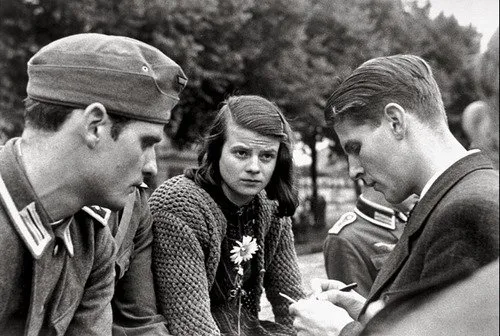
The Scholl siblings. Credit to Jim Forest.
Sophie Scholl and Hitler Youth
After the Nazis came to power in January 1933, Sophie, along with most of her siblings, was an excited and happy follower of the National Socialist cult, joining Hitler Youth against the wishes of their parents.
Like many of her contemporaries, Sophie was particularly intrigued by the focus on nature and communal experiences. She joined the BDM, the Bund Deutscher Mädel (League of German Girls).
Robert was a critic of the party from the beginning, who had raised their children firmly grounded in the Christian tradition, Robert Scholl viewed the developments in Germany and their children’s interest in Nazism with growing fear and horror.
A fracture in belief
Sophie’s siblings, especially her oldest brother Hans, who later went on to become a founding member of the Weiße Rose, were members of non-Nazi groups of young people.
These associations shared and propagated a love for nature, outdoor adventures, as well as the music, art and literature of German Romanticism. Originally seen as compatible with Nazi ideology, these groups were slowly dissolved, and finally banned by 1936.
Hans remained active in one such group, however, and was arrested in 1937 along with several of the Scholl siblings. This arrest left a mark on Sophie’s conscience, and began the process that eventually turned her from happy supporter of the Nazi system to active resistance fighter.
WWII breaks out
On 1 September 1939, Hitler invaded Poland and, two days later, France and Britain declared war on Germany.
Sophie graduated high school in the spring of 1940, and started an apprenticeship to become a kindergarten teacher, eventually wanting to study biology and philosophy.
In order to be admitted, students had to spend a period of time working for the state in the Reichsarbeitsdienst (RAD; National Labour Service).
She hated the military-like regimen and mind-numbing routine. She longed for an autonomous life, an end to the war, and for happiness with her boyfriend Fritz Hartnagel, who was now fighting on the Eastern front. Her doubts about the regime grew.
When she finally moved to Munich to study biology and philosophy in May 1942, her brother, Hans, a medical student at the same university, had already begun to actively question the system. Serving on the Eastern Front, he learned about the crimes committed in Poland and Russia first hand.
Pamphlets by the White Rose
Starting in June 1942, the White Rose – namely Alexander Schmorell and Hans Scholl – began printing and distributing leaflets in and around Munich, calling their fellow students and the German public to action.
As a student, Sophie had seen the flyers and applauded their content as well as their authors’ courage to speak truth to power. She did not want to stay passive anymore. By January 1943, Sophie had joined the inner circle of the White Rose.
The White Rose’s core were siblings Hans and Sophie, and their fellow students Alexander Schmorell, Willi Graf, Christoph Probst, and a professor of philosophy and musicology at the University of Munich, Kurt Huber.
Together they published and distributed six pamphlets. They sent them to professors, booksellers, authors, friends and others—going through phone books for addresses and hand-writing each envelope.
In the end, they distributed thousands, reaching households all over Germany. Acquiring such large amounts of paper, envelopes, and stamps at a time of strict rationing without raising suspicion was problematic, but the students managed by engaging a wide-ranging network of supporters in cities and towns as far north as Hamburg, and as far south as Vienna. These networks were also activated to distribute the pamphlets, attempting to trick the Gestapo into believing the White Rose had locations all across the country.
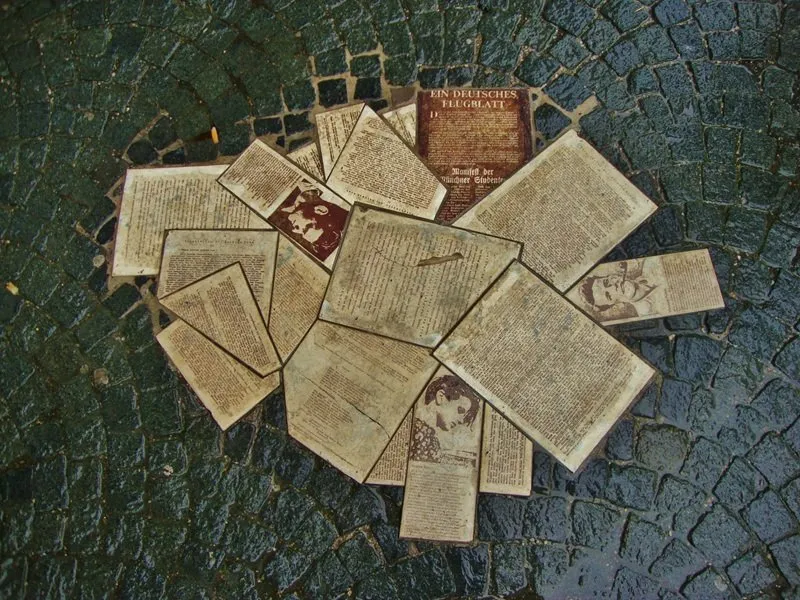
The Leaflet Memorial for Hans and Sophie Scholl, University of Munich. Taken by Alex JD.
Sophie’s spiritual life
Sophie Scholl’s transition from a disillusioned student to a defiant resister was deeply anchored in her spiritual and intellectual life.
Sophie Scholl wasn’t just a political rebel; she was a philosophical one. She used the 1,500-year-old wisdom of a North African bishop, St. Augustine of Hippo, to see through the propaganda of a modern “thousand-year” Reich.
Augustine’s philosophy provided her with a moral framework to judge the Nazi state as not just a political failure, but a theological “nothingness” or “evil.”
Sophie began to view the Nazi “New Order” not as a legitimate structure, but as a void where justice and love should have been. It stripped the regime of its perceived glory, and revealed it as a hollow dictatorship of evil.
Augustine was one of the first to codify the requirements for a ‘Just War’. He argued that while peace is the goal, some wars are necessary to stop grave injustices.
Seeing the atrocities on the Eastern Front, the White Rose used this logic to justify internal resistance. If a state is waging an unjust war and committing crimes, the ‘peace’ it demands from its citizens is actually a sin.
For a young woman trapped in a system that demanded total outward conformity, Augustine offered a ‘theology of the heart’. This allowed Sophie to maintain her autonomy even while performing the “mind-numbing” work required by the state.
Sophie famously wrote in her diary, “my soul is hungry.” This mirrors Augustine’s most famous quote: “Our heart is restless until it rests in You.”
Augustine’s philosophy suggests that an unjust law is no law at all. This gave the White Rose the intellectual ‘permission’ to commit treason against a criminal government.
The end of the White Rose
On 22 February 1943, Sophie, Hans, and Christoph Probst were arrested after a nazi- sympathetic janitor reported them distributing pamphlets.
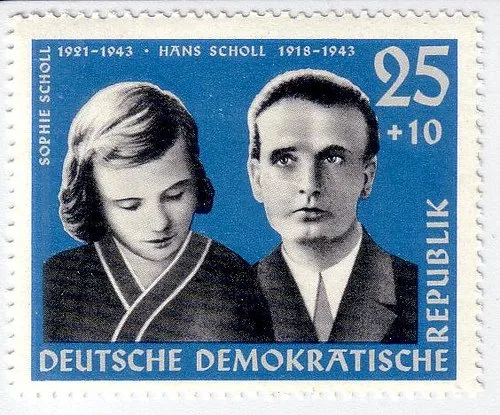
White Rose stamp depicting Hans and Sophie Scholl. Credit to Jim Forest.
They were executed for treason by guillotine. Officials also eventually arrested and executed philosophy professor Kurt Huber and the rest of the White Rose members.
Sophie was only 21 years old at the time of her execution. After her death, copies of the final White Rose leaflet were air-dropped over Germany by the Allies.
Her story has been depicted in several films, books, and other media, including the Oscar-nominated film Sophie Scholl – The Final Days.
Looking at the current global geopolitical situation, maybe it’s time to remind ourselves that ‘dictatorships of evil’ have not died out with Hitler’s Germany.
We mustn’t let Sophie and the White Rose’s sacrifice be forgotten – this International Women’s Day, let us remember Sophie Scholl, and her dedication to standing against fascism.

